
5 ChatGPT Features Every Researcher Must Use in 2026 (Save 100+ Hours)

Research has never been short of ideas. What it has always lacked is time.
Whether you are a PhD scholar, an early-career researcher, or a seasoned academic, you already know how much effort goes into brainstorming topics, narrowing research questions, reviewing literature, managing references, analyzing data, and finally writing a structured document that meets academic standards. In 2026, working harder is no longer the solution. Working smarter is.
ChatGPT has evolved into one of the most practical research support tools available today. Used correctly, it can save more than 100 hours across the research lifecycle, without replacing your intellectual ownership or academic responsibility.
Below are five ChatGPT features every researcher must use in 2026, explained with real academic use cases.
Five ChatGPT features every researcher must use in 2026
1. Deep Research Mode for Literature Reviews with References
One of the most time-consuming parts of research is writing literature reviews. Searching databases, screening papers, organizing themes, and formatting citations can take weeks.
ChatGPT’s Deep Research feature changes this workflow.

Instead of asking for a generic literature review, researchers can now:
Define a clear title
Specify the field of research
Limit the time range (for example, the last five years)
Choose a citation style such as APA
Mention specific sub-themes or applications

Once prompted correctly, ChatGPT asks clarifying questions, such as:
Which field are you focusing on?
Should the review emphasize recent developments?
Are there specific applications like data analysis, hypothesis generation, or clinical AI?
This step is critical. It forces you to refine vague ideas into precise academic queries.
The output includes:
A structured literature review
In-text citations
A reference list
Clickable sources for cross-checking
You remain responsible for verification and refinement, but the heavy lifting is already done. What once took 7–10 days can now be completed in a few focused sessions.
2. Topic Refinement and Research Gap Identification
Many researchers struggle not because they lack ideas, but because their ideas are too broad.
ChatGPT excels at turning raw ideas into academically sound research directions.
If you input a general topic such as “Applications of AI in medical research.”

ChatGPT helps by:
Narrowing the scope
Identifying high-impact subdomains
Highlighting under-explored areas
Aligning topics with recent literature trends
For example, it may guide you toward:
Explainable AI for clinical decision support systems
Federated learning for multi-institutional medical imaging
Privacy-preserving AI under regulatory constraints
Each suggested direction can include:
Rationale for the study
Possible data sources
Expected contributions
Suitable methodologies
This feature is especially powerful for PhD researchers who need to justify novelty and relevance. Instead of guessing research gaps, you work with structured academic reasoning.
3. Step-by-Step Document Development Using Outlines
One common mistake researchers make is writing everything at once. This leads to poor flow, repeated editing, and loss of control over structure.
ChatGPT allows you to build documents step by step.
A recommended workflow:
Feed ChatGPT a comprehensive title
Ask for a detailed outline based on the document type
Review and refine the headings
Generate sections individually (500, 2000, or 3000 words)
Edit each section before moving forward
This controlled approach results in:
Better logical flow
Less rewriting at the end
Reduced proofreading time
Higher consistency in tone and structure
Whether you are writing a proposal, systematic review, thesis chapter, or research article, this method keeps the writing process manageable and transparent.
4. Thinking Mode for Brainstorming and Methodology Design
ChatGPT’s Thinking Mode is not about getting final answers. It is about understanding how ideas are formed.

Researchers can use this feature to:
Brainstorm PhD research ideas
Explore multiple perspectives on one topic
Identify suitable research methodologies
Understand why certain approaches are preferred
For example, if you ask: “Suggest high-impact PhD research ideas in AI for medical research.”
ChatGPT provides:
Well-scoped research ideas
Brief justifications
Possible methods
Relevant data sources
Expected academic contributions
You can go further and ask: “Suggest popular methodologies to conduct this research, with references.”
This helps researchers make informed decisions rather than blindly following trends. The thinking process mirrors how experienced academics evaluate research problems.
5. Data Analysis and Concept Explanation Support
Not every researcher is equally comfortable with statistics, equations, or complex data interpretation.
ChatGPT acts as an interactive academic assistant that:
Explains complex mathematical or statistical concepts
Walks through equations step by step
Helps interpret patterns in research data
Assists in hypothesis testing logic
Instead of simply giving results, ChatGPT asks questions such as:
What is your goal for analysis?
How many variables are involved?
What type of data do you have?
Based on your responses, it explains:
Appropriate analytical approaches
Relationships between variables
How results connect to research questions
This ensures that you understand your data rather than just reporting outcomes, which is essential for thesis defense and journal submissions.
Bonus: Image and Diagram Creation for Research Communication
Visual representation is becoming increasingly important in research.
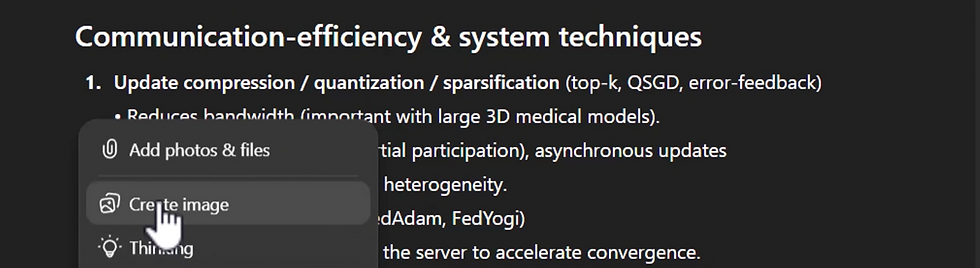
ChatGPT can help you:
Design thematic diagrams
Structure conceptual frameworks
Create prompts for research visuals
Generate multiple diagram variations
By feeding details such as research objectives, variables, and relationships, you can produce structured prompts that can later be refined in tools like Canva or other design platforms.
This is particularly useful for:
Thesis diagrams
Research proposals
Conference presentations
Grant applications
Conclusion
ChatGPT in 2026 is not just a writing tool. It is a research assistant designed to support thinking, structuring, validating, analyzing, and communicating research. When used strategically, it can save more than 100 hours across a single project while improving clarity and academic quality.
The key is not to outsource your research, but to collaborate with the tool. You remain the researcher. ChatGPT becomes the system that reduces friction, not responsibility.
If you are serious about research efficiency and quality, these five features are no longer optional. They are essential.
If you want practical guidance on using AI tools correctly for research, writing, and data analysis, follow ScientificPakistan. Explore, test these features hands-on, and start transforming the way you conduct research in 2026.


One of the best things about Wacky Flip is its simple controls combined with tricky mechanics. It’s easy to learn, but mastering the perfect flip takes real skill and practice.