
7 Best Platforms to Find Research Positions | PhD, MS & Research Jobs Worldwide (2026)

Every year, thousands of fully funded PhD positions, postdoctoral fellowships, research assistantships, and faculty jobs are advertised around the world. Yet many qualified researchers never even see these opportunities. Instead, they spend hours searching on Google or LinkedIn, believing those are the only places where research jobs are posted.
The reality is different.
Universities, research institutes, government organizations, and private R&D companies often advertise positions on specialized academic job platforms before they appear anywhere else. These platforms are built specifically for researchers and allow you to search based on your discipline, research interests, funding opportunities, and academic experience.
Whether you are an undergraduate looking for a research internship, an MS graduate planning a PhD, a PhD student searching for a postdoctoral position, or an experienced researcher seeking faculty opportunities, using the right platform can significantly improve your chances of finding relevant positions.
In this article, you'll discover seven of the best platforms for finding research jobs worldwide in 2026. You'll also learn what makes each platform unique, who should use it, and practical tips to search more effectively.
1. ResearchGate Jobs – The Best Platform for Researchers with Publications
Research is more than a job—it's your academic reputation. That's exactly where ResearchGate has an advantage over traditional job boards.
Most researchers already use ResearchGate to upload publications, follow other scientists, and build collaborations. However, many never explore its dedicated Jobs section, which regularly features PhD positions, postdoctoral fellowships, research assistantships, and academic vacancies from universities worldwide.

Why ResearchGate Jobs stands out
Instead of functioning as a simple job board, ResearchGate connects your academic identity directly with available research opportunities.
Some of its biggest advantages include:
Your research profile supports your application.
When recruiters review your application, they can access your ResearchGate profile, including your publications, citation metrics, research interests, project contributions, and collaborations. This provides additional evidence of your research experience beyond a traditional resume.
Search jobs by research discipline.
Rather than searching with broad terms like "scientist" or "research assistant," you can search using highly specific academic fields such as Molecular Biology, Artificial Intelligence, Environmental Science, Computational Chemistry, Biomedical Engineering, Data Science, or Neuroscience.
This helps you find positions that closely match your expertise.
Filter opportunities by location.
If you're planning to study or work abroad, you can search multiple countries simultaneously. Whether you're targeting Germany, Canada, Australia, the UK, or Singapore, ResearchGate makes it easy to narrow your search geographically.
Access opportunities from universities worldwide.
ResearchGate hosts vacancies from universities, government research organizations, research institutes, and industry laboratories, making it suitable for researchers at different career stages.
How to search effectively on ResearchGate
Searching randomly often produces irrelevant results. Instead, follow a structured approach:
Open the Jobs section on ResearchGate.
Enter your research specialization instead of a general job title.
Select one or more countries where you want to work.
Choose your research discipline carefully.
Review each position individually before applying.
Enable email alerts so new vacancies arrive automatically.
2. Nature Careers – The Gold Standard for STEM and Life Science Research Jobs
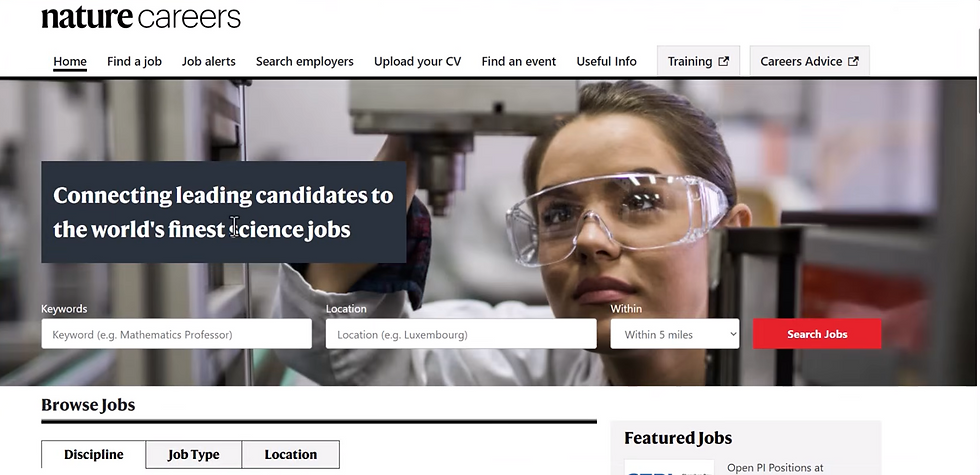
If your goal is to work at a leading university, research institute, or global life sciences company, Nature Careers should be one of the first platforms you visit. It is part of the Nature Publishing Group, one of the most respected names in scientific publishing, making it a trusted source for high-quality academic and research opportunities.
Key Features
Specialized STEM and life science opportunities
Nature Careers focuses on disciplines such as biology, chemistry, medicine, engineering, physics, environmental science, and other STEM fields. This makes it easier to find jobs relevant to your research background.
Advanced search filters
You can search using keywords, research discipline, country, job type, or organization. These filters help narrow hundreds of listings to positions that match your qualifications.
Jobs from globally recognized institutions
Many vacancies come from well-known universities, research institutes, pharmaceutical companies, and biotechnology organizations, giving applicants access to highly competitive opportunities.
Detailed job descriptions
Each listing usually includes eligibility requirements, required qualifications, salary information (when available), contract duration, and application deadlines, allowing you to evaluate a position before applying.
Direct application links
Most jobs include an Apply Now button that redirects you to the employer's official recruitment portal, where you can complete your application.
How to Search Effectively
To find relevant positions:
Use your exact research discipline as the keyword instead of broad terms like "research."
Filter results by country, job type, and subject area.
Read the complete job description before applying.
Tailor your ATS-friendly CV using the important keywords mentioned in the vacancy.
Set up job alerts to receive newly published opportunities in your field.
3. Google Jobs – Search Thousands of Research Positions in One Place
Many researchers don't realize that Google is more than just a search engine—it also functions as one of the largest job search tools available through Google Jobs.
When you search for a research position on Google, it automatically collects job listings from university websites, LinkedIn, Indeed, ResearchGate, company career pages, and many other sources. Instead of visiting multiple websites individually, you can explore opportunities from different platforms in one search.

Key Features
Aggregates jobs from multiple websites
Google gathers listings from universities, companies, and popular job boards, saving you time during your search.
Powerful search filters
You can filter results by location, posting date, employment type, employer, and sometimes salary estimates.
Easy keyword searches
Searching with specific phrases such as "Postdoctoral Research Fellow AI" or "Computational Biology PhD Position" produces much better results than generic keywords.
Links directly to the original source
Google does not host applications itself. Instead, it redirects you to the official university or employer website where you complete your application.
How to Search Effectively
To get the best results:
Search using your exact research specialization.
Place important job titles inside quotation marks for more precise results.
Filter jobs by country and posting date.
Check recent listings regularly since research vacancies can close quickly.
Always apply through the official university or organization's website.
4. EURAXESS – The Best Platform for Fully Funded Research Positions in Europe
If you're planning to build your research career in Europe, EURAXESS is one of the most valuable platforms you can use. It is an official initiative of the European Commission that connects researchers with universities, research institutes, and organizations across Europe.
Unlike many general job boards, EURAXESS focuses specifically on research and innovation. Many positions listed on the platform are supported by major European funding programmes, making it an excellent resource for researchers looking for stable, well-funded opportunities with clear employment terms.
Key Features
Verified research opportunities
Every vacancy is posted by a recognized university, research institute, or organization, giving applicants greater confidence in the authenticity of the position.
Access to funded research projects
Many listings are linked to prestigious European research funding programmes, offering competitive salaries, research budgets, and long-term career development opportunities.
Search by multiple filters
You can filter vacancies by research field, country, organization, career stage, funding programme, or employment type, making it easier to find positions that match your academic background.
Detailed vacancy information
Most job advertisements include information about the project, eligibility criteria, salary (where available), required qualifications, application deadlines, and contact details.
Support beyond job searching
EURAXESS also provides information about researcher mobility, visas, relocation, and living in different European countries, making the transition easier for international researchers.
How to Use EURAXESS Effectively
Start by selecting Job Opportunities from the main menu and entering your research field or specialization as a keyword. Instead of using broad terms like "science" or "engineering," search with specific fields such as Biomedical Engineering, Computational Chemistry, Renewable Energy, or Artificial Intelligence.
Apply filters for your preferred country, career stage, or funding programme to narrow your search. Once you find a suitable position, read the complete job description carefully before applying through the employer's application portal.
Since many European research positions receive applications from around the world, make sure your CV, cover letter, and supporting documents are tailored to the specific requirements mentioned in the advertisement. Paying attention to these details can significantly improve the quality of your application.
5. HigherEdJobs – A Leading Platform for Academic Careers in the United States
If your goal is to work at a university in the United States, HigherEdJobs is one of the most trusted platforms available. It specializes in higher education careers and publishes thousands of vacancies from colleges, universities, and research institutions across the country every year.
The platform is particularly useful for researchers who are interested in faculty positions, postdoctoral appointments, research scientist roles, and academic leadership opportunities. Because universities regularly advertise their vacancies here, it has become a popular resource for both employers and job seekers in higher education.

Key Features
Dedicated to higher education careers
Unlike general job websites, HigherEdJobs focuses entirely on colleges and universities, making it easier to find academic positions without sorting through unrelated listings.
Wide range of academic opportunities
The platform includes faculty jobs, postdoctoral fellowships, research positions, laboratory roles, administrative appointments, and teaching opportunities across various disciplines.
Advanced search options
You can search using keywords, subject area, institution, job category, or location to quickly identify relevant openings.
Comprehensive job descriptions
Most listings clearly outline the required qualifications, responsibilities, application documents, and deadlines, helping applicants prepare complete submissions.
How to Use HigherEdJobs Effectively
Search using your academic discipline rather than a generic keyword. For example, instead of searching Faculty, use Biochemistry Faculty, Computer Science Professor, or Mechanical Engineering Researcher.
Before applying, carefully review the list of required documents. Many U.S. universities request more than just a CV. Depending on the position, you may also need a research statement, teaching statement, cover letter, publication list, diversity statement, or reference letters.
In many cases, clicking Apply redirects you to the university's own recruitment portal. Always complete your application there and double-check that every required document has been uploaded before submitting. A complete application package is often just as important as your qualifications.
6. LinkedIn Jobs – The Best Platform for Industry Research and R&D Careers
While LinkedIn is widely known as a professional networking platform, it has also become one of the largest sources of research and development (R&D) job opportunities worldwide. Many pharmaceutical companies, biotechnology firms, AI laboratories, engineering companies, and research organizations actively recruit through LinkedIn.
Unlike academic-focused platforms, LinkedIn offers a mix of opportunities from both universities and private organizations. This makes it an excellent choice for researchers who want to move beyond academia or explore industry-based research careers.
Key Features
Large collection of research and R&D jobs
LinkedIn features opportunities from multinational companies, startups, government organizations, universities, and research institutes.
Powerful networking opportunities
You can connect with professors, recruiters, hiring managers, and researchers working in your field. Building professional connections can help you discover opportunities that may not be widely advertised.
Easy job filtering
Search results can be filtered by location, experience level, remote work, company, and date posted, making it easier to find relevant positions.
Company insights
Before applying, you can view company information, employee profiles, recent updates, and workplace details to better understand the organization.
How to Use LinkedIn Effectively
Complete your LinkedIn profile before applying for any position. Include your education, research experience, publications, projects, technical skills, certifications, and achievements. A well-optimized profile increases your credibility and helps recruiters understand your background.
When searching, use specific job titles instead of broad keywords. For example, search for Machine Learning Researcher, Biomedical Scientist, Materials Scientist, or Research Engineer rather than simply typing "research jobs."
It is also worth turning on job alerts, so you're notified whenever new positions matching your interests are posted.
7. Indeed – A Great Platform for Academic and Industry Research Jobs
Indeed is one of the world's largest job search platforms and hosts millions of vacancies across different industries. Although it is not exclusively designed for researchers, it remains a valuable resource for finding research-related positions in universities, pharmaceutical companies, government agencies, healthcare organizations, think tanks, and private research laboratories.
One of Indeed's biggest strengths is its extensive database. Because employers from many sectors advertise their vacancies here, researchers can explore both academic and non-academic career paths without switching between multiple websites.
If you're considering a transition from academia to industry, Indeed can help you identify opportunities that match your research expertise while introducing you to roles you may not have previously considered.

Key Features
Global job database
Search for research positions from universities, private companies, hospitals, government organizations, and research institutes across many countries.
Simple keyword-based search
Enter your research field, preferred job title, or technical specialization to quickly discover relevant vacancies.
Online resume feature
Indeed allows you to create and save an online resume, making it faster to apply for multiple jobs without repeatedly uploading the same information.
Job alerts
You can receive notifications whenever new research positions matching your search criteria become available.
How to Use Indeed Effectively
Create a complete Indeed profile and keep your online resume updated with your latest education, publications, technical skills, and research experience.
When searching, combine your specialization with the position you're targeting. For example, use searches such as Clinical Research Scientist, Environmental Research Assistant, or AI Research Engineer instead of simply typing "research."
Before applying, always review the original job description carefully and tailor your CV to match the required qualifications. Even though Indeed simplifies the application process, submitting a customized application will usually produce better results than sending the same resume to every employer.
Comparison of the 7 Best Research Job Platforms (2026)
Choosing the right platform depends on your career stage and the type of research position you're looking for. Some platforms are designed specifically for academic careers, while others are better suited for industry research and development (R&D) roles.
Platform | Best For | Career Stage | Primary Focus | Geographic Coverage |
ResearchGate Jobs | Researchers with publications | Early to Mid Career | PhD, Postdoc, Academic Research | Global |
Nature Careers | STEM and Life Science researchers | Mid to Senior Career | Academic and Industry Research | Global |
Google Jobs | Researchers searching across multiple websites | All Career Stages | Academic and Industry Jobs | Global |
EURAXESS | Researchers seeking funded European positions | Early to Mid Career | PhD, Postdoc, Research Projects | Europe |
HigherEdJobs | Faculty and university researchers | Mid to Senior Career | Higher Education and Faculty Roles | United States |
LinkedIn Jobs | Industry researchers and R&D professionals | All Career Stages | Corporate Research, Innovation, R&D | Global |
Indeed | Researchers moving into industry | All Career Stages | Academic, Government, Industry | Global |
Tips to Increase Your Chances of Getting Selected
Finding the right platform is only the first step. Your application plays an equally important role in determining whether you receive an interview invitation.
Here are a few practices that can improve your chances:
Customize your resume for every application. Avoid sending the same CV to every employer. Match your skills and experience with the requirements mentioned in the job description.
Use an ATS-friendly resume. Many universities and companies use Applicant Tracking Systems (ATS) to screen applications before they reach a hiring committee. A well-structured resume with relevant keywords has a better chance of passing these systems.
Keep your academic profiles updated. Platforms like ResearchGate and LinkedIn should reflect your latest publications, projects, certifications, and research experience.
Set up job alerts. New research positions are posted every day, and many have short application windows. Email alerts help you apply early.
Prepare your supporting documents in advance. Many academic positions require a cover letter, research statement, teaching statement, publication list, and reference letters. Having these documents ready allows you to submit complete applications without unnecessary delays.
Apply consistently. Research positions are highly competitive, and receiving a rejection is part of the process. The more relevant applications you submit, the greater your chances of securing interviews and offers.
Conclusion
Finding the right research position is no longer about searching on a single job website. Today, universities, research institutes, government organizations, and private R&D companies advertise opportunities across multiple specialized platforms, each serving a different purpose. By using the right combination of platforms, you can discover vacancies that match your research interests, career stage, and long-term goals.
Whether you're applying for a fully funded PhD, a postdoctoral fellowship, a faculty position, or an industry research role, the key is to stay proactive. Keep your CV updated, tailor every application, maintain a strong academic profile, and set up job alerts so you never miss new opportunities.
Remember, successful researchers don't wait for opportunities to come to them—they build a systematic approach to finding them. Start with two or three platforms that align with your goals, apply consistently, and refine your application materials with every submission. A strategic job search can make all the difference in securing your next research position.
At Scientific Pakistan, we help students, researchers, and academics build successful research careers. From creating ATS-friendly academic CVs and writing compelling cover letters to preparing research statements and applying for fully funded PhD and postdoctoral positions, our expert guidance is designed to improve your chances of success.


I usually play during short breaks, and Drive Mad loads quickly without asking for anything extra. Easy to jump in for a few levels.