
Before Your Paper Gets Rejected, Try This Jenni AI Peer Review Feature

Every year, thousands of research papers and thesis are rejected not because the research itself is weak, but because the document fails at critical academic standards. The problem is rarely the idea—it is the structure, clarity, citations, and overall academic presentation that break down under peer review.
Most researchers only discover these weaknesses after submission, when rejection emails or reviewer comments arrive. By that point, fixing the paper becomes stressful, time-consuming, and in many cases, discouraging.
This is exactly where the peer review feature of Jenni AI changes the academic writing process.
Instead of waiting for rejection, researchers can now simulate peer review before submission, identify weak areas, and refine their manuscript with precision.
You can explore the tool here: Jenni AI
Discount code: RIZ20
Understanding Why Research Papers Get Rejected
Before understanding the tool, it is important to understand the real reasons behind rejection. Most papers fail not at the idea stage, but at the communication stage.
A research paper can contain strong data, but still be rejected if the argument is unclear or poorly structured. Similarly, missing citations or outdated references weaken the credibility of the entire work, even if the research is technically sound.
Another major issue is methodological inconsistency. Many researchers describe a method but fail to justify it properly or connect it with research objectives. Reviewers immediately flag such gaps.
In simple terms, rejection often comes from a weak presentation of strong research rather than weak research itself.
What Makes Jenni AI Peer Review Different
Jenni AI introduces a structured peer review system that analyzes your paper as an academic reviewer would. Instead of just proofreading grammar, it evaluates the research at a deeper level.
When you upload your paper, it does not treat it like a normal document. It breaks it into sections, analyzes arguments, checks academic tone, and evaluates the strength of your contribution.
This is important because real peer review is not just about language correction. It is about academic validity, logic, and research depth.
Step-by-Step: How the AI Peer Review Actually Works
When you paste your research paper into Jenni AI and run the review feature, the system begins a structured evaluation process.
Instead of giving a single generic response, it evaluates multiple academic dimensions separately.
It first scans the structure of the document, checking whether sections like abstract, methodology, and conclusion are logically connected. This helps identify missing flow or broken academic progression, which is a common reason for rejection.
Then it analyzes argument strength and clarity. If your claims are not properly supported or if your reasoning is unclear, the system highlights those areas and suggests improvements that align with academic expectations.
It also checks methodological consistency, ensuring that your research design matches your objectives. If there are gaps or unclear explanations, it flags them for revision.
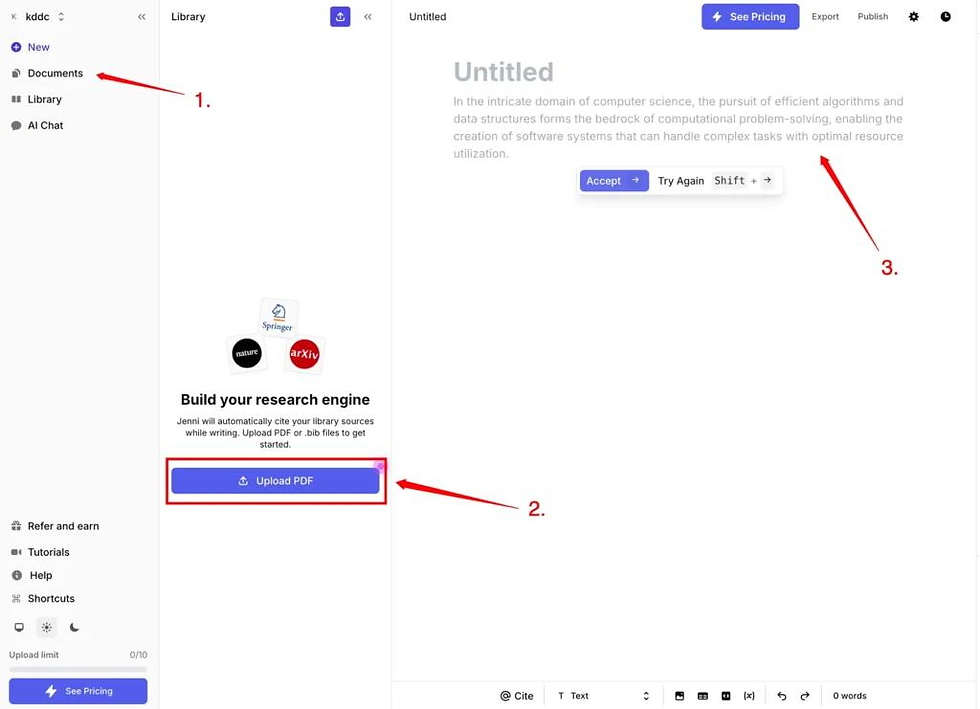
Each section is reviewed independently, which gives you a detailed map of what needs improvement instead of vague feedback.
The Real Value: It Thinks Like a Reviewer, Not Just a Tool
One of the strongest advantages of Jenni AI is that it simulates the mindset of an academic reviewer.
For example, it does not only say “improve literature review.” Instead, it may point out that recent studies from 2024–2025 are missing and that this weakens the relevance of your research contribution.
This kind of feedback is extremely valuable because it mirrors what journal reviewers actually write in rejection reports.
In many cases, it also raises critical questions about your methodology. These are not random suggestions; they are structured academic concerns that reflect real peer review standards.
This means you are not guessing what might be wrong—you are seeing it before submission.
Using AI Feedback to Improve Each Section of Your Paper
Once the review is completed, Jenni AI provides section-by-section feedback.
This is where the real improvement begins.
For instance, when it highlights a weak abstract, it does not stop at identification. It also suggests what should be strengthened, such as clarifying the research gap or improving the problem statement.
Similarly, if the methodology section is unclear, it points out where justification is missing and how it can be improved to meet academic expectations.
You can then use its AI editing feature to directly refine that section based on reviewer comments. This creates a continuous improvement loop where every weak point is corrected systematically.
However, the important academic practice here is not to blindly accept changes.
Researchers must evaluate each suggestion critically to ensure it aligns with their research intent and discipline standards.

Grammar, Tone, and Academic Writing Quality
Beyond structural review, Jenni AI also performs detailed language refinement.
It checks grammar, punctuation, repetition, and vocabulary usage. More importantly, it evaluates academic tone, ensuring your writing aligns with formal scientific standards.
You can even select writing styles such as formal, concise, or scientific, depending on your discipline requirements.
This step is crucial because even strong research can be rejected if the language appears inconsistent or non-academic in tone.

Why This Matters for Modern Researchers
The research landscape has become highly competitive. Journals receive thousands of submissions, and even minor weaknesses can lead to rejection.
Tools like Jenni AI help researchers move from reactive improvement (after rejection) to proactive refinement (before submission).
This shift changes the entire academic workflow:
Instead of guessing what reviewers might say, you can simulate that process in advance and fix problems early.
Important Academic Note
Even though AI tools significantly improve writing quality, researchers must ensure that their final submission reflects original thinking and proper academic integrity.
AI suggestions should guide refinement, not replace critical analysis or intellectual contribution.
A well-reviewed paper still requires human judgment to maintain authenticity, originality, and scientific accuracy.
Conclusion
Jenni AI’s peer review feature is not just a writing assistant—it is a pre-submission academic reviewer that helps identify weaknesses before journals do.
It evaluates structure, clarity, methodology, argument strength, and academic tone in a way that closely resembles real peer review systems.
For researchers, this means fewer rejections, stronger manuscripts, and a more efficient writing process.
Instead of waiting for feedback after rejection, you can now improve your paper before it ever reaches a reviewer.
That shift alone can significantly increase the chances of publication success.
If you are working on a thesis, research paper, or journal submission, you can explore Jenni AI here: Jenni AI
Use discount code RIZ20 for access benefits.
For more research tools, academic writing strategies, and AI-powered workflows, follow Scientific Pakistan and stay updated with practical research innovations.



I find practical networking articles more useful when they explain both the purpose of an address and the situations where it may be relevant. Information about 10.0.0.0.1 piso wifi time can help users understand time-related configuration features when managing their own network equipment.
If you enjoy skill-based driving games, eggy car is worth a try. Every small mistake changes the outcome, which keeps each run interesting.