
From Literature Review to Writing — Claude Does It All in FREE for Research

What if your literature review could move from scattered PDFs and messy notes to a structured, reference-backed draft within a single working session?
For many researchers, the hardest part of academic writing is not intelligence or effort. It is structured. It is verifying references. It is maintaining academic tone while managing deadlines. Students often turn to free large language models for help. The problem? These tools frequently generate references that do not exist, provide weak citations, or produce generic content that lacks scholarly depth.
There is one tool that is changing that experience for researchers. Claude offers structured writing support and provides literature-backed outputs in its free version. When used responsibly, it can support your research process from brainstorming to structured drafting.
The Common Mistake Researchers Make with AI
Many students copy and paste AI-generated content directly into their research documents.
This leads to:
Unverified references
High AI detection scores
Poorly structured arguments
Weak academic credibility
Research writing requires authentic, traceable sources. It demands clarity of thought, critical analysis, and strong citation practice. Any AI tool must support this process—not replace your academic responsibility.
What Makes Claude Different for Research Writing?
When you access Claude, you will notice that it is not just a chat interface. It provides structured writing support through guided prompts and thoughtful outputs.
You can use Claude for:
Generating PhD research topic ideas
Creating detailed research outlines
Writing structured literature reviews
Drafting research proposals
Improving academic tone
Developing discussion and conclusion sections

For example, imagine your research area is “dissolution of cellulose in ionic liquids.” You can ask Claude to:
Suggest unexplored research gaps
Develop a thematic outline for the literature review
Write a structured draft with recent scholarly references
Organize citations at the end
The output typically follows academic logic: introduction, thematic analysis, comparative discussion, and reference list.
However, it is important to understand something clearly: the generated document will likely show AI detection. You must rewrite, restructure, and critically analyze the content before using it in your final submission.
Claude should be treated as a research assistant—not your final author.
How Claude Supports Literature Review Writing
One of the strongest aspects of Claude is its approach to structuring literature reviews.
Instead of producing random paragraphs, it organizes content logically:
Introduction to the research domain
Historical development of the topic
Recent advancements and studies
Comparative analysis of findings
Identified research gaps
Proper reference listing
You can first ask Claude to generate an outline. Then you can refine the outline. After that, request a specific word count draft following your defined structure.
When references are generated, always:
Copy the DOI
Cross-check through Google Scholar
Confirm journal authenticity
Verify publication year
Never rely blindly on any AI output. Verification is part of responsible research.
Built-in Academic Productivity Features
Claude is not limited to writing research papers. It also supports academic workflows.
You can create:
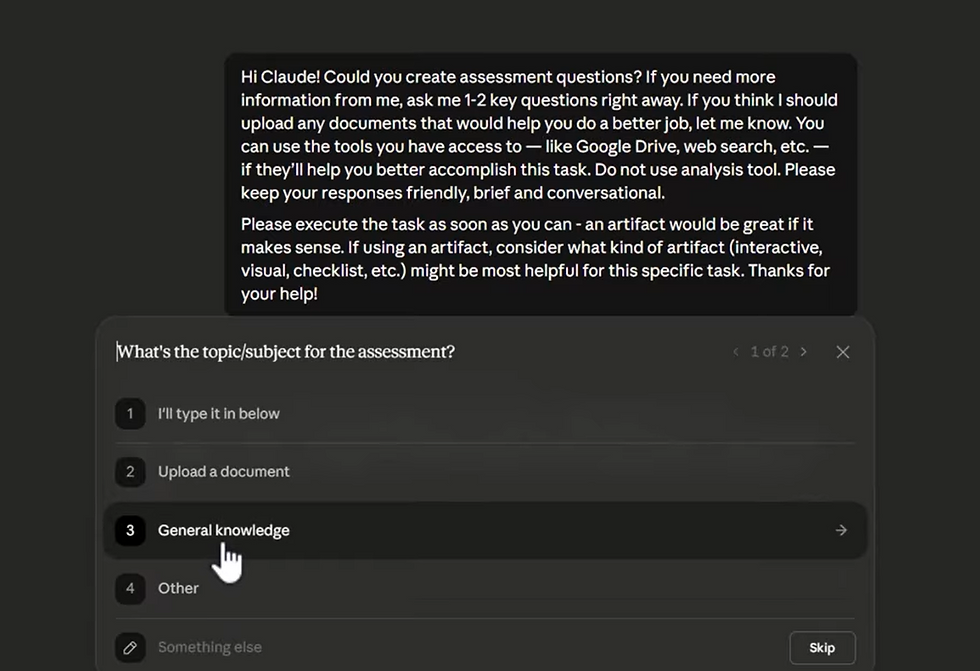
MCQs for classroom assessments
True/false tests
Short-answer exams
Knowledge maps
Learning frameworks
Technical code for analysis

The tool asks clarifying questions before generating output. This customization improves accuracy and relevance. Once generated, assessments can be downloaded, edited, or shared through live links.
For academic instructors, this becomes a time-saving feature. For researchers, it supports teaching responsibilities alongside research work.
Beyond Research: Daily Academic Planning
Claude also helps researchers with:
Converting personal goals into action plans
Creating structured morning routines
Improving time management
Design
In productivity systems
Academic life requires a balance between research, teaching, and personal growth. A structured plan reduces burnout and increases consistency.
Comparison with Other AI Research Tools
The AI ecosystem offers multiple tools for researchers:

NotebookLM is useful for interacting with uploaded research papers. Gemini integrates smoothly with Google services. Google AI Studio provides a more technical environment for developers. Opal focuses on experimental AI exploration.
Claude’s strength lies in structured academic drafting with literature-supported content in a free interface. It balances accessibility with academic usefulness.
How to Use Claude Without Risking Plagiarism
Using AI responsibly is essential.
Follow this workflow:
Use Claude for brainstorming ideas.
Generate a structured outline.
Request a draft for understanding the topic flow.
Verify every reference independently.
Rewrite the content in your own academic language.
Add your critical evaluation and interpretation.
Run plagiarism checks before submission.
Remember, AI-generated text without modification may trigger AI detection systems.
Academic integrity must remain your priority.
From Writing Block to Structured Research
Writer’s block is common in academia. Many researchers know their topic but struggle to start writing. Claude helps in:
Organizing scattered thoughts
Structuring arguments logically
Identifying missing research gaps
Refining discussion sections
Improving clarity and tone
Instead of staring at a blank page, you begin with a structured draft that you refine and strengthen.
Conclusion
Research writing demands accuracy, structure, and credibility. Many AI tools can generate text. Few provide structured, reference-backed academic drafting support in a free environment.
Claude can assist researchers from literature review development to proposal drafting and structured discussion writing. When used responsibly—with verification and rewriting—it becomes a valuable academic support tool.
AI should not replace your research thinking. It should expand it.
If you want practical guidance on using AI tools responsibly in academia, explore more research-focused content at ScientificPakistan and improve your academic workflow today.


Comments