
SciSpace Just Changed Research Forever (2026 Updates You Must See!)

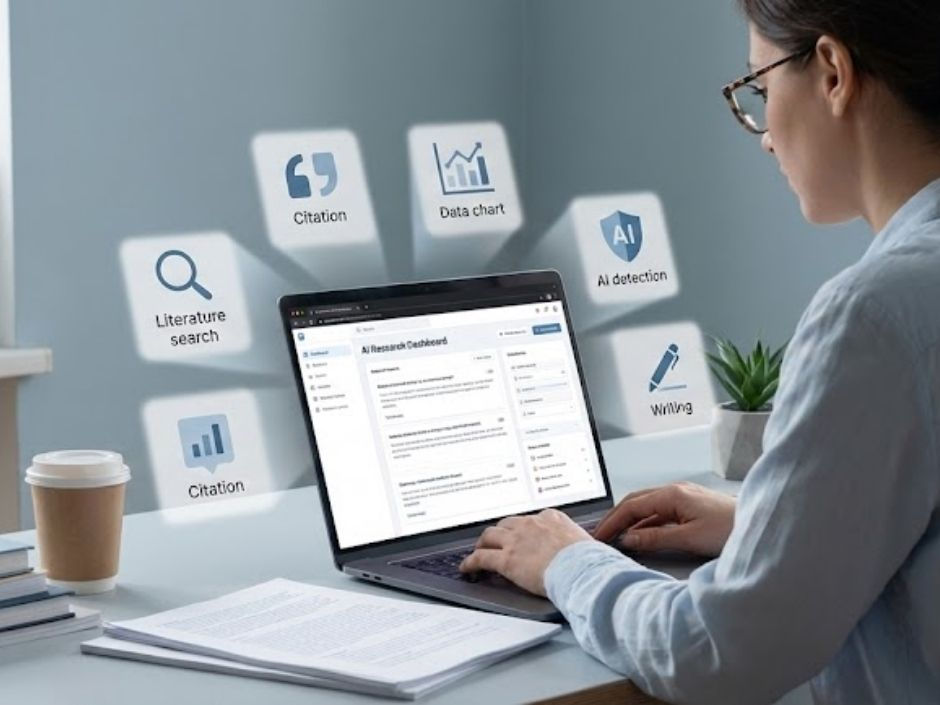
Research has always been demanding—but managing hundreds of PDFs, writing literature reviews, checking citations, and formatting reports manually is what truly slows researchers down. If you are a student, PhD scholar, or academic struggling to keep up with these tasks, the 2026 updates to SciSpace may completely change how you work.
SciSpace’s latest release is not just another AI update. It fundamentally redefines how researchers interact with their own literature, write reports, and manage references—all from one intelligent workspace.
In this article, we break down the most important SciSpace 2026 updates and explain why they matter for modern research workflows.
What Is SciSpace and Why Do Researchers Rely on It
SciSpace is an AI-powered research platform designed to help researchers read, understand, organize, and write scientific content efficiently. Instead of switching between PDF readers, reference managers, and writing tools, SciSpace brings everything into a single environment.
With the 2026 update, SciSpace has moved beyond simple paper summarization and introduced deep library intelligence, AI-driven report writing, citation-aware notebooks, and Zotero integration—features that directly address real research pain points.
You can access SciSpace
Smart Research Libraries That Actually Understand Your Papers
One of the biggest improvements in SciSpace 2026 is its enhanced My Library feature.

Researchers can now:
Upload multiple PDFs and organize them into custom folders
Create topic-specific libraries for different projects
Add custom columns such as conclusions, limitations, methods, or summaries
Instantly view AI-generated snapshots of each paper
Instead of opening each PDF manually, SciSpace provides short, structured summaries highlighting the main findings, limitations, and research focus of every paper. This gives researchers a quick overview of large literature collections in minutes, not days.
Ask Questions Directly From Your Own PDF Collection
SciSpace now allows you to ask research questions directly from your uploaded papers.

For example, you can ask:
“What are the major applications of ionic liquids as solvents?”
“What limitations are commonly reported across these studies?”
SciSpace extracts answers only from your selected library, ensuring relevance and accuracy. The generated content includes in-text citations and a reference list, making it easier to verify sources and maintain academic integrity.
This feature is especially valuable for:
Literature review writing
Comparative analysis
Identifying research gaps
Synthesizing results across studies
Save Everything Into Notebooks With One Click
Another major upgrade is the Notebook system.
Any output generated in SciSpace—whether it’s a chat response, a summarized section, or a full research document—can be saved directly into a notebook.

Researchers can:
Rename notebooks
Organize content by project
Edit and reuse saved outputs later
Change citation styles instantly
This removes the need to copy-paste content into external documents and keeps all research writing safely stored in one place.
Zotero Integration for Seamless Reference Management
Reference management is often one of the most frustrating parts of research.
SciSpace now integrates directly with Zotero, allowing researchers to:
Import Zotero libraries into SciSpace
Ask questions from Zotero-stored papers
Generate cited content using Zotero references
Maintain consistency across research projects

This integration bridges the gap between reference management and AI-assisted writing, saving researchers hours of manual work.
AI-Powered Research Report Writing That Follows Academic Structure
One of the most powerful features introduced in the 2026 update is AI-based research report writing.
When you request a document—such as a literature review, systematic review, or research report—SciSpace:
Identifies the correct academic structure
Searches and evaluates relevant papers
Displays live activity showing paper relevance and abstracts
Synthesizes content with in-text citations
Produces a fully structured report with references
For example, when writing a report on the limitations of ionic liquids as solvents, SciSpace automatically generates:
Executive summary
Table of contents
Detailed introduction
Section-wise limitations
Referenced conclusions
The result is a comprehensive, academically formatted document that researchers can edit, save, and download instantly.
Download, Edit, and Reuse Without Friction
Once a document is complete, SciSpace allows users to:
Download files in organized folders
Access references via DOI links
Save documents for future updates
Reuse content for extended research or publication drafts
This makes SciSpace a complete research lifecycle tool rather than just a reading assistant.
Pricing and Discount Codes
SciSpace offers free access with premium plans for advanced features.
To get the best price, use the following coupon codes:
RIJAN40 – 40% off (Annual plan)
RIJAN20 – 20% off (Monthly plan)
Access SciSpace using this link to apply the discounts
Why SciSpace 2026 Matters for Researchers
The 2026 updates focus on solving real research challenges:
Managing large PDF collections
Writing structured academic documents
Maintaining citation accuracy
Reducing manual effort
Improving research productivity
SciSpace does not replace critical thinking—but it removes repetitive, time-consuming tasks so researchers can focus on analysis, interpretation, and innovation.
Conclusion
SciSpace’s 2026 update represents a significant shift in how researchers read, write, and manage scientific content. By combining intelligent PDF interaction, AI-driven report writing, integrated reference management, and organized notebooks, SciSpace has positioned itself as one of the most practical research tools available today.
For researchers struggling with literature overload and manual writing processes, SciSpace offers a smarter, faster, and more reliable way forward.
If you want more practical insights on research tools, AI in academia, and scholarly writing, explore expert-driven content on ScientificPakistan—where research meets clarity.


What attracts me in Top Free Games is the fact that all its games are about gameplay. I would like to avoid having to go through some tedious process when looking for a game to play. Having the ability to browse games and start their gameplay immediately makes the whole process more effective. It is important for casual gamers as the aim is just to have fun.