
Turnitin 2026 vs AI Humanizers – The Truth Researchers Must Know

Artificial Intelligence has quietly become part of almost every researcher’s workflow. From literature reviews to drafting proposals, AI tools are now deeply embedded in academic writing.
But at the same time, a second system is evolving just as fast — AI detection technology.
And this is where confusion starts.
Many researchers believe AI humanizers can fully bypass Turnitin. Others think Turnitin flags everything AI touches.
The truth sits somewhere in between — and it is far more important to understand in 2026 than ever before.
How AI Writing Starts in the Research Workflow
Before we talk about Turnitin or humanizers, we must understand how AI writing actually enters research.
Most researchers today follow a similar flow:
AI is used for drafting and brainstorming ideas: This stage helps researchers quickly generate paragraphs, outlines, and topic directions. However, the output is usually structurally predictable and easy for detection tools to identify later.
AI tools generate citation-based content: Tools like Grok or ChatGPT can include references and scholarly links. While useful, these citations are sometimes synthetic or need verification from real academic databases.
The content is directly copied into documents: This is where most problems begin. The raw AI output, even if useful, carries patterns that modern AI detectors can easily recognize.
Access the tool:
Discount code DRRIZWANA20
What Happens When You Upload AI Content to Turnitin
When AI-written content is submitted to Turnitin in 2026, the system performs two separate checks:
AI writing detection system: This is the most important part. Turnitin analyzes writing patterns, sentence structure, predictability, and linguistic behavior to determine if the text resembles AI-generated writing.
A key insight researchers often miss is this:
Low plagiarism does NOT mean safe submission anymore.

Why AI Detection is Now the Real Issue
AI detection is becoming stricter because universities are shifting focus from copying to authorship authenticity.

This means:
Even original AI-generated content can be flagged: The system does not care if the content is unique. It cares whether the writing “feels human” or “feels machine-generated.”
Paraphrasing is no longer a guaranteed solution: Even if you rewrite AI text manually or through tools, sentence structure patterns can still reveal AI involvement.
Writing style consistency is analyzed: AI often produces uniform sentence lengths and predictable transitions, which are strong detection signals.
What Are AI Humanizers Actually Doing?
AI humanizers are tools designed to modify AI-generated text so it appears more natural and less machine-like.
But they do NOT “remove AI content.”

Instead, they:
Change sentence structure and flow: This makes the writing less predictable and more varied, which reduces AI detection signals but does not eliminate them completely.
Replace repetitive AI patterns: AI often repeats similar phrasing styles. Humanizers try to break that repetition by rewriting sentences in different formats.
Adjust tone and academic style: Some tools attempt to make content more formal or natural depending on the selected mode (academic, casual, technical).

Safe Write AI – Step-by-Step Process
Safe Write is designed for academic rewriting with a structured approach.
Here is how the process works:
Step 1: Paste your AI-generated content: The user inputs raw AI-written text into the platform. This content is usually flagged by Turnitin if submitted directly.
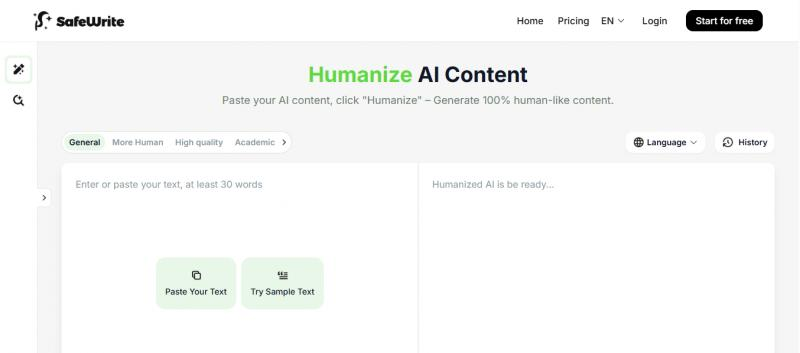
Step 2: Select “Academic Mode”: This mode ensures rewriting is aligned with a formal academic tone. It focuses on sentence restructuring rather than casual paraphrasing.
Step 3: Humanize the text: The tool rewrites the entire document while highlighting modified words. This helps users track what has been changed during processing.
Step 4: Review output before export: Researchers can compare the original vs rewritten text to ensure meaning is not lost during transformation.

In practical testing, Safe Write showed significantly reduced AI detection, making it appear more effective in structured academic rewriting.
Stealth Writer AI – How It Works
Stealth Writer focuses more on customization and control during rewriting.
Here is how researchers typically use it:
Step 1: Insert AI-generated document: The full text is uploaded into the system for processing. This includes research drafts, essays, or literature reviews.

Step 2: Set rewriting intensity: Users can choose how many sentence variations to generate. Higher variation means more rewriting, but also a higher risk of meaning distortion.
Step 3: Add protected keywords: Important scientific terms, variables, or technical phrases can be locked so they remain unchanged during rewriting.
Step 4: Generate multiple outputs: The tool provides different rewritten versions so users can select the most suitable one.

However, even after processing, Turnitin may still detect AI patterns in the final output depending on the structure and rewriting depth.
Comparison Insight – What the Results Really Show
From observed comparisons:
Safe Write reduced AI detection more effectively in structured tests: The rewriting style was more aggressive in sentence restructuring, which helped reduce detectable AI patterns significantly.
Stealth Writer preserved meaning better but reduced detection less: It focused more on controlled rewriting, which sometimes still retained AI-like sentence flow.

This shows an important conclusion:
Better humanization does not always mean better academic safety — it depends on how deeply the structure is rewritten.
The Real Truth Researchers Must Understand
The biggest misunderstanding in 2026 is this:
AI humanizers are NOT a guaranteed bypass for Turnitin.
Instead:
They are rewriting tools, not detection breakers: Their job is to improve readability and reduce patterns, not guarantee invisibility.
Turnitin continues to evolve: AI detection models are trained on newer datasets, meaning older humanization strategies become less effective over time.
Human review is still essential: Academic writing requires interpretation, argumentation, and originality — something AI tools cannot fully replicate.
Conclusion
Turnitin 2026 is no longer just a plagiarism checker — it is an AI authorship detection system.
At the same time, AI humanizers like Safe Write and Stealth Writer are improving writing quality and reducing machine-like patterns, but they are not foolproof solutions.
The real shift researchers must understand is this:
Success in academic writing is no longer about bypassing systems — it is about combining AI assistance with genuine human thinking.
AI should support your research process, not replace your intellectual contribution.
If you want more in-depth, practical breakdowns of AI tools, research workflows, and academic writing systems, follow Scientific Pakistan for structured guides designed specifically for researchers, students, and academics.


Excellent analysis of Turnitin 2026 vs AI humanizers! The distinction between rewriting tools and detection breakers is crucial for researchers. For those exploring AI writing tools and detection systems, cookie clicker unblocked offers interesting resources.
If you enjoy skill-based driving games, eggy car is worth a try. Every small mistake changes the outcome, which keeps each run interesting.
Fans of classic sports games will appreciate how Retro Bowl combines nostalgic presentation with modern gameplay features that keep every season fresh and exciting.