
Your Literature Review Should Not Take a Week | Finish it Today: Scispace

You sit down to work on your literature review, thinking you will finish a few papers today. Hours later, you have dozens of PDFs, countless browser tabs, scattered notes, and still no clear picture of what the research actually says. The problem is not always that there is too much literature; it is that the traditional process of searching, opening, screening, reading, extracting, and organising papers can be extremely time-consuming. Researchers often depend on a few keywords, which can cause relevant studies using different terminology or describing the same concept in another way to remain hidden in search results.
A strong literature review is not about collecting as many papers as possible. It is about finding the right evidence, comparing studies, identifying patterns and contradictions, and connecting previous findings to your own research question. With AI-assisted research tools and semantic search, researchers can now search using the meaning and context of their research problem rather than relying only on exact keywords. In this article, we will explore a practical workflow that can help you move from an empty search bar to a structured, evidence-based literature review much faster—while still keeping source verification and your own academic judgment at the centre of the process.
Try SciSpace
Use code: ATRIZ35
Get 35% off the Max plan + 40,000 credits.
Step 1: Stop Searching for Keywords. Start Searching for Meaning.
Traditional database searching largely depends on matching words.
Semantic search takes a different approach.
Instead of asking:
“Which papers contain these exact keywords?”
the search process tries to identify:
“Which research discusses the concept represented by this question?”
This distinction can make a significant difference when your research question contains several interconnected concepts.
For example, instead of searching only:
“green synthesis silver nanoparticles plant extract”
you could describe the research problem more naturally:
What studies have investigated the synthesis of silver nanoparticles using plant-derived materials, particularly how plant composition and reaction conditions influence nanoparticle characteristics?
The second query communicates relationships between concepts rather than simply listing terms.
SciSpace currently combines semantic and text-based search approaches and says its ranking prioritises relevance rather than simply relying on citation counts. Its search system draws from multiple research sources and a corpus of more than 200 million papers.
Why this matters for your literature review
A strong literature review is not built by finding papers that contain the same words as your research question.
It is built by finding papers that contribute evidence to the question you are trying to answer.
That means your search strategy should include:
The exact terminology used in your research question
Alternative terminology used by researchers
Related concepts
Theoretical terminology
Methodological terminology
Different ways authors describe the same phenomenon
The goal is not to collect more papers. The goal is to reduce the number of irrelevant papers you have to process.
Step 2: Turn Your Research Question Into a Search Strategy
One reason literature reviews become painfully slow is that researchers start searching before defining exactly what they need to find.
They have a topic, but not a search structure.
Consider:
Topic: Online shopping
That is far too broad.
Build your search around concepts, not just words
For every major variable in your research, ask:
What other terms could researchers use to describe this concept?
This exercise prevents your review from becoming dependent on one particular vocabulary.
And this is exactly where semantic search can reduce manual effort: you can begin with the meaning of the research problem rather than spending hours creating dozens of keyword combinations.
Step 3: Don't Read 50 Papers From Page One to the Last Page
This is where many literature reviews become unnecessarily slow.
A researcher finds 40 papers and decides:
“I need to read all of them.”
Not necessarily.
You need to screen them first.
Reading every paper completely before deciding whether it belongs in your review is an inefficient workflow.
Instead, use a staged reading process.
Stage 1: Relevance
Ask:
Does this paper actually address my research question?
Is my population relevant?
Is the context relevant?
Does it examine one of my variables?
Does it contribute evidence that I can use?
Stage 2: Research design
Then examine:
What methodology did the researchers use?
What was the sample?
What variables were tested?
What theoretical framework was used?
What analytical technique was applied?
Stage 3: Findings
Only after that should you spend substantial time extracting:
Main findings
Relationships between variables
Contradictory findings
Limitations
Recommendations
This changes your workflow from:
Find → Download → Read everything → Take notes
to:
Search → Screen → Prioritise → Analyse → Synthesize
That difference alone can save hours.

Step 4: Use Deep Search When Your Question Is Complex
A simple search can be useful when you already know exactly what paper you are looking for.
But literature reviews often require something more complicated.
You may want to know:
What are the major findings across recent research?
Or:
What methodologies have researchers used to investigate this relationship?
Or:
What evidence exists for the relationship between these two variables?
These are not ordinary keyword searches.
They are research questions.
SciSpace's Deep Review is designed for this type of broader literature analysis. According to SciSpace's current documentation, Deep Review uses semantic and text-based methods, gathers research from multiple sources, and organises findings around themes, trends, gaps, methodologies, and sources.
This changes the role of the search engine.
Instead of using it simply as:
“Give me papers.”
you can use it as:
“Help me map the evidence surrounding this research question.”
That is a much more useful starting point for a literature review.

Step 5: Don't Judge an AI Research Tool by Its First Result
This point is extremely important.
A tool returning an answer in five seconds does not automatically mean it is producing good research.
Speed is not evidence of accuracy.
A search tool can give you 20 papers very quickly—but if 12 are only loosely related to your question, you have not saved time. You have simply moved the work somewhere else.
This is why researchers should evaluate:
Relevance
Source quality
Coverage
Recency
Citation accuracy
Methodological fit
Whether the original paper actually supports the claim
SciSpace's research team published a benchmark comparing AI scholarly search systems across 200 complex queries. Their evaluation used three independent AI models to judge the relevance of returned papers. In that benchmark, SciSpace Deep Review reported the highest average number of highly relevant papers among the tested systems and led in precision across most ranking depths.
There is an important qualification here: this was a SciSpace-conducted benchmark, so researchers should interpret the results with that context in mind rather than treating the benchmark as an independent universal ranking.
The larger lesson is more important than the ranking:
Evaluate the search process, not just the speed of the search.
Step 6: Build Your Evidence Base Before You Start Writing
One of the most common mistakes is opening Microsoft Word and immediately writing:
“According to previous studies…”
Then searching for a citation to support the sentence.
That reverses the research process.
A better workflow is:
Evidence → comparison → synthesis → argument → writing
For each important paper, capture information such as:
Research objective
Context
Sample
Methodology
Variables
Theory
Main findings
Limitations
Relevance to your research
Possible research gap
You do not necessarily need a complicated spreadsheet.
The important thing is to create an evidence structure.
For example:
Theme | Study A | Study B | Study C |
Positive effect | Positive effect | Insignificant | |
Security | Significant | Significant | Mixed |
Repurchase intention | Positive | Positive | Positive |
Context | UK | China | Pakistan |
Method | PLS-SEM | SEM | Regression |
The value of this structure is not the table itself.
It is the comparison.
Now you can see something that is almost impossible to notice when reading PDFs separately:
Study A and Study B agree, while Study C produces a contradictory finding.
That contradiction may become one of the most valuable parts of your literature review.

Step 7: Stop Summarising Papers One by One. Start Synthesising Them.
This is probably the biggest difference between a basic literature review and a strong academic literature review.
A weak paragraph looks like this:
Smith (2022) found that trust influences repurchase intention.Ahmed (2023) found that trust influences online shopping behaviour.Khan (2024) found that trust affects customer retention.
You have cited three papers.
But you have not really reviewed the literature.
A stronger version asks:
What do these studies collectively tell us?
Now the studies are being synthesised.
The literature review is no longer a sequence of summaries.
It has become an argument.
Think in relationships
Instead of:
Paper A → finding
Paper B → finding
Paper C → finding
Think:
Paper A + Paper B + Paper C → common pattern → disagreement → possible explanation → research gap
That is where academic writing begins.

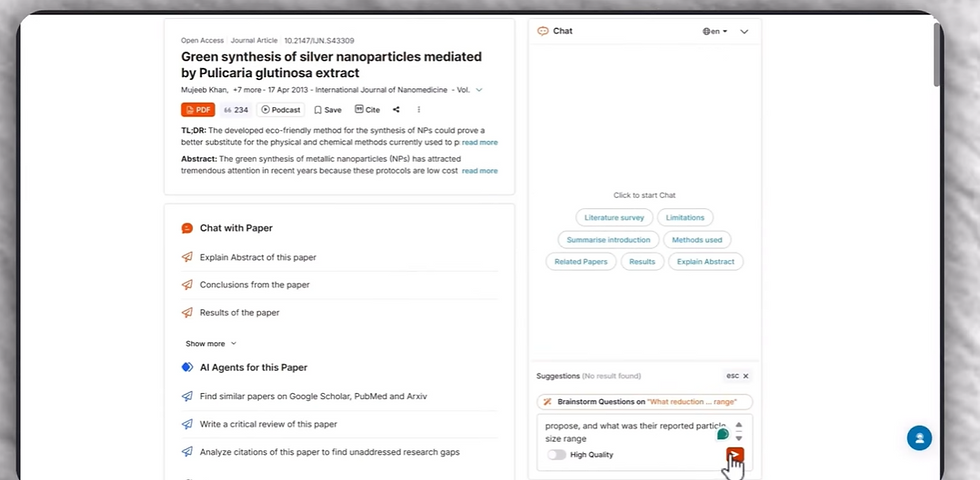
Step 8: Ask Questions Directly From the Paper
Finding a relevant paper is only the beginning.
You still need to extract useful information from it.
Suppose you have a 30-page paper and your specific question is:
What measurement scale did the researchers use for perceived security?
You do not necessarily need to read 30 pages line by line.
If the full text is available, tools such as SciSpace allow researchers to interact with papers and ask targeted questions about their contents. SciSpace's current literature-review workflow also supports opening papers, analysing them, and asking follow-up questions through its paper-reading interface.
You could ask:
What was the sample size?
What theory was used?
What were the independent variables?
What statistical method was applied?
What were the significant relationships?
What limitations did the authors identify?
What future research did they recommend?
This is much more efficient than repeatedly scrolling through PDFs looking for one specific sentence.
But there is an important rule:
Always verify important information against the original paper.
AI-assisted extraction is a research aid, not a replacement for reading the evidence.
Step 9: Don't Let Paywalls Break Your Research Workflow
Another major source of wasted time is access.
You finally find the perfect paper.
You click PDF.
Then:
“Purchase access.”
Or:
“Institutional login required.”
At this point, researchers often leave the paper and begin searching again.
But if your university already subscribes to the journal, the problem may simply be that your research environment is not connected to that institutional access.
SciSpace provides library-related functionality that can allow researchers to work with papers available through their institutional access within the research environment. Availability will depend on the institution, subscription, and authentication setup.
The bigger idea is simple:
Do not confuse “I cannot access this paper right now” with “this paper does not exist.”
For a serious literature review, access strategy matters because some of the most relevant studies may not be freely available through ordinary search results.
Step 10: Use Quantitative Findings Instead of Collecting Only Abstracts
A literature review becomes much stronger when you move beyond:
“Most studies found a positive relationship.”
Ask:
How strong was the relationship?
What sample was used?
What statistical method was used?
Was the relationship significant?
Did the effect change across contexts?
Were there contradictory results?
Quantitative evidence allows you to compare studies more critically.
For example, rather than writing:
Several studies found that perceived security affects trust.
you might build a synthesis around:
Direction of relationship
Effect size where available
Significance
Sample characteristics
Research context
Measurement approach
Analytical technique
This allows you to move from describing research to evaluating research.
Some SciSpace literature-review outputs can surface structured information and quantitative findings from the papers being analysed, which can be useful as an initial evidence-mapping stage.
Again, treat extracted numbers as something to verify against the original publication before putting them into your thesis or manuscript.

Step 11: Verify Every Citation Before It Enters Your Thesis
This is where researchers need to be especially careful with AI.
An AI-generated sentence can sound academically perfect while containing:
An incorrect citation
A citation that does not support the claim
An outdated source
A misinterpreted finding
A citation attached to the wrong study
Therefore, never follow this workflow:
AI writes paragraph → copy → paste into thesis
Use:
AI-assisted search → identify source → inspect source → verify claim → read context → write synthesis → cite original paper
SciSpace's Deep Review documentation describes source-linked analysis where researchers can inspect the original source and relevant excerpts behind generated insights.
That source traceability is important because a citation is not decoration.
It is evidence.
If your sentence says:
“Previous research demonstrates that…”
the paper you cite should actually demonstrate what you are claiming.

Step 12: Use AI to Reduce the Mechanical Work—Not the Intellectual Work
This is the principle that should guide your entire literature review.
AI can help you:
Search
Screen
Extract
Compare
Organise
Summarise
Identify patterns
Generate an initial structure
Locate potentially relevant evidence
But you still need to:
Decide what evidence matters
Evaluate study quality
Interpret contradictory findings
Determine whether a research gap is genuine
Decide how studies relate to your research question
Develop your argument
Write the final academic synthesis
Think of AI as reducing research friction.
It should not remove research judgment.

Step 13: Combine SciSpace With Your Writing Workflow
Once your evidence has been gathered and verified, the next challenge is turning it into coherent academic writing.
This is where integrations with general-purpose AI tools can become useful.
SciSpace currently supports a broader research workflow around literature search, paper analysis, organisation, and citation-backed writing. Its documentation also describes workflows where literature findings can be organised and subsequently used for drafting.
For example, you can structure your workflow as:
Research question
↓
Semantic search
↓
Relevant papers
↓
Screening
↓
Evidence extraction
↓
Comparison
↓
Themes and contradictions
↓
Research gap
↓
Draft structure
↓
Academic writing
↓
Citation verification
This is far more efficient than asking a general AI tool:
“Write me a literature review about my topic.”
The latter may produce fluent text.
But fluency is not the same as scholarship.
Step 14: You Can Compress a Week of Work Into One Focused Day
Let's make the workflow practical.
Instead of spending seven days jumping between databases, PDFs, Word documents and browser tabs, divide the day into focused stages.
Morning: Define and Search
Start by writing your research question clearly.
Then identify the major concepts and alternative terminology.
Run broad semantic searches first.
Your objective is not to collect 200 papers.
Your objective is to understand the research landscape.
Late Morning: Screen
Remove papers that are:
Clearly irrelevant
Outside your research context
Methodologically unsuitable
Duplicates
Too far from your research question
Keep the strongest candidates.
At this point, you should have a manageable evidence pool rather than an enormous folder of PDFs.
Afternoon: Extract and Compare
For the most relevant papers, extract:
Theory
Method
Sample
Variables
Findings
Limitations
Context
Research gaps
Then compare them.
Ask:
Where do researchers agree?
Where do they disagree?
What has been studied repeatedly?
What has been overlooked?
Which populations or contexts are underrepresented?
What methodological limitations remain?
Late Afternoon: Build the Literature Review Structure
Now organise your findings by themes, not by publication date alone.
For example:
1. Conceptual foundations
Define your main concepts and explain how researchers have conceptualised them.
2. Theoretical perspectives
Compare the theories used to explain the phenomenon.
3. Empirical evidence
Group studies according to the relationships or themes they investigate.
4. Contradictory findings
Explain where studies disagree and why those differences may exist.
5. Research gaps
Show what remains insufficiently investigated.
6. Connection to your study
Explain exactly where your research fits.
This structure gives the literature review a logical progression.
Step 15: The Final Few Hours Should Be About Synthesis, Not Searching
This is where many researchers make another mistake.
They keep searching.
Another paper.
Another paper.
Another paper.
Eventually, the literature review becomes an endless project.
At some point, you need to stop collecting and start thinking.
Ask yourself:
If I had to explain the entire literature in five key arguments, what would they be?
Those five arguments can become the backbone of your review.
For example:
Argument 1: Existing research consistently establishes the importance of consumer trust.
Argument 2: Post-purchase services can influence consumers' willingness to continue using an online retailer.
Argument 3: Payment-method perceptions may influence trust through security, usefulness, and ease of use.
Argument 4: Existing evidence is fragmented across different markets and consumer groups.
Argument 5: Limited research has integrated these factors within the specific context being investigated.
Now you are no longer simply reporting papers.
You are constructing an academic argument.
That is what your literature review should ultimately do.
A One-Day Literature Review Workflow
Here is the entire process in one place:
Step 1 — Define the question
Write exactly what your review needs to answer.
Step 2 — Expand the concepts
Identify alternative terminology and related concepts.
Step 3 — Run semantic searches
Search by meaning and research questions, not only exact keywords.
Step 4 — Screen aggressively
Do not read every paper in full.
Step 5 — Prioritise evidence
Identify the studies most directly relevant to your question.
Step 6 — Extract systematically
Capture methods, theories, samples, findings and limitations.
Step 7 — Compare studies
Look for agreements, contradictions, and methodological differences.
Step 8 — Identify themes
Group evidence around meaningful research themes.
Step 9 — Find the gap
Ask what remains unanswered—not simply what has never been studied.
Step 10 — Write the synthesis
Connect multiple studies within each argument.
Step 11 — Verify citations
Check every important claim against the original source.
Step 12 — Edit critically
Remove repetition and make sure every paragraph contributes to your research argument.
The purpose of this workflow is not to make research careless or rushed.
It is to eliminate unnecessary manual work so that your time is spent on the part AI cannot responsibly do for you: critical academic judgment.
Try SciSpace for Your Next Literature Review
If you are currently spending days searching, downloading, and manually screening research papers, SciSpace can help streamline several parts of the process—from semantic literature search and paper analysis to deeper literature review workflows and source organisation.
You can try SciSpace here:
Try SciSpace
Use code: ATRIZ35
Get 35% off the Max plan + 40,000 credits.
Use the tool as a research assistant—not as a replacement for your academic judgment. Always verify important claims, statistics, interpretations, and references against the original papers before including them in your thesis, dissertation, or publication.
Conclusion: Your Literature Review Does Not Need Seven Days of Chaos
A literature review takes too long when the workflow is built around collecting papers rather than building evidence.
If you search only by keywords, open every result manually, download dozens of PDFs, read them from beginning to end, copy isolated findings into a document, and only then try
to identify themes, a simple literature review can easily consume an entire week—or longer.
A better workflow begins with the research question.
Search semantically.
Screen intelligently.
Prioritise the strongest evidence.
Extract information systematically.
Compare studies instead of merely summarising them.
Identify patterns and contradictions.
Build your research gap from the evidence.
Then write.
AI tools such as SciSpace can significantly reduce the mechanical workload involved in finding and analysing literature, particularly when you use features such as semantic search, deeper literature analysis, and paper-level questioning. But the final responsibility remains with the researcher.
The objective is not to produce a literature review as quickly as possible.
The objective is to remove the wasted hours so you can spend more time thinking like a researcher.
So the next time you open a blank document and think:
“This literature review is going to take me a week.”
Stop.
Define the question.
Build the search.
Find the evidence.
And start reviewing with a workflow—not with 50 browser tabs.
Need support with your research?
Scientific Pakistan provides academic and research support for students and researchers, including research writing guidance, literature review support, thesis and dissertation guidance, research proposal development, and academic editing.
Visit Scientific Pakistan to explore research support and resources.


Comments